Rocket fault delays the launch of Nasa’s solar probe
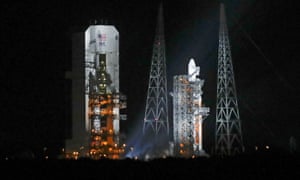
As the first rays of dawn reached Cape Canaveral on Saturday, the rocket that Nasa hopes will reveal the sun’s secrets remained very much earthbound.
A last-minute technical hitch forced controllers at the Florida space centre to cancel the night-time launch of the Parker Solar Probe, announcing that they would try again on Sunday.
With one minute and 55 seconds left on the countdown timer, a launch controller ordered “Hold, hold, hold” when a pressure alarm sounded, showing that there was a fault with the Delta IV Heavy rocket’s helium system. Engineers tried to identifiy the problem, but the launch window – when a spacecraft can take off in the right direction due to the Earth’s rotation – closed before they could make progress.
United Launch Alliance, which made the rocket, will make a second attempt to launch the probe at 8.31am UK time on Sunday, although Nasa said that there was only a 60% chance of favourable weather conditions.
The probe, the size of a small car, is due to make a seven-year mission to skim through the sun’s atmosphere, enduring temperatures of 1,300C. Its flightpath will use the gravitational pull of Venus as a slingshot to propel it at speeds of 430,000 mph towards the sun’s corona. The probe will circle the star and then go back around Venus, gradually getting closer to the sun’s surface.
The probe is protected by a 4in-thick shield that constantly repositions itself between the sun’s power and the scientific instruments on board.
Reaching the required speed means the Parker Solar Probe needs one of the most powerful rockets ever built. The Delta IV Heavy holds 600 tonnes of liquid hydrogen and liquid oxygen, so Cape Canaveral’s controllers are unlikely to take any risks.
Thousands of spectators gathered in the middle of the night on Friday to witness the launch, including the University of Chicago astrophysicist for whom the spacecraft is named. Eugene Parker predicted the existence of solar wind 60 years ago. He’s now 91 and eager to see the solar probe soar. He plans to stick around at least another few days.
Since you’re here…
… we have a small favour to ask. More people are reading the Guardian than ever but advertising revenues across the media are falling fast. And unlike many news organisations, we haven’t put up a paywall – we want to keep our journalism as open as we can. So you can see why we need to ask for your help.
The Guardian is editorially independent, meaning we set our own agenda. Our journalism is free from commercial bias and not influenced by billionaire owners, politicians or shareholders. No one edits our Editor. No one steers our opinion. This is important because it enables us to give a voice to the voiceless, challenge the powerful and hold them to account. It’s what makes us different to so many others in the media, at a time when factual, honest reporting is critical.
If everyone who reads our reporting, who likes it, helps to support it, our future would be much more secure. For as little as £1, y
 SPACE VENTURE